Showing posts with label Focus. Show all posts

The Four Boxes of Assessment Feedback Literacy

Aligning Assessment Literacy to Learning Outcomes

by Tan Heng Kiat, Kelvin (NIE)

Assessment feedback efficacy should be understood as a vital component of Assessment for Learning (Tan, 2013). According to the Ministry of Education, Assessment for Learning “is primarily used for ensuring that the intended learning outcomes are achieved by students”. Hence, how well assessment is understood and used for learning should be directed towards ensuring that students achieve their intended learning outcomes. There is therefore a need to make connections between what teachers know about assessment, and how that eventually and systematically leads to students’ attainment of learning outcomes.

Four boxes can be used to illustrate how assessment literacy may lead to learning outcomes. This four-box theory of aligning teachers’ assessment literacy to students’ learning outcomes may be represented in the context of assessment feedback as follows: 


Given that assessment and feedback is one of the four teaching processes of the Singapore Teaching Practice, it is common for teachers in Singapore to spend a great deal of time attending professional development workshops and courses in assessment feedback literacy. It is in the interests of teachers and students for new knowledge of assessment feedback theories and practices to be translated into enhancing or even ensuring learning for students.

However, teachers who attend such training but fail to apply their assessment literacy knowledge to their classrooms and school contexts may be said to remain only in Box 1. Application of and reflection on assessment feedback theory is therefore required to ensure that teachers are able to move to Box 2 to adjust or improve their assessment feedback practices. This requires intentionality on the part of teachers, in particular to be clear whether feedback for students is intended at the task, process, and/or self-regulated levels (Hattie & Timperley, 2007).

However, what teachers intend for their students to derive from teachers’ feedback comments would not be actualised if students do not read or act on the feedback in the first place. Hence, to ensure that teachers’ feedback practices are not stuck in Box 2, how students understand and are inclined to act on feedback needs to be considered. This therefore requires teachers to ensure that feedback is actionable for students, and to persuade students of the utility and benefits of acting on feedback. Such agentic engagement with feedback is termed as proactive recipiences by Winstone et al. (2017), and is defined as ‘a state or activity of engaging actively with feedback processes, thus emphasizing the fundamental contribution and responsibility of the learner’ (p. 17).

Whilst Boxes 1 and 2 represent what teachers need to know and do, Box 3 represents the reality that feedback efficacy ultimately depends on what students actually do with feedback, rather than on what kinds of feedback are provided by teachers. But proactive recipience of feedback in itself merely means that assessment feedback efficacy is represented by Box 3. To ensure that Box 4 is reached as a goal, i.e., for students to actually benefit from acting on feedback, the focus needs to shift from students’ activity with feedback, to students learning from feedback.

The journey from Box 1 to Box 4 represents the chronology that begins with assessment knowledge, to application by teachers, to action by students, and finally for the learning benefits for students.  However, the thought process of a curriculum leader starts with the ends in mind, and begins with the vital curriculum question of what students need to learn (Box 4). This then indicates what students need to do (Box 3) in order to process, enhance, and evidence their learning. The question(s) that Box 3 poses about learning in turn prods the teacher to consider the feedback advice and actions (Box 2) that enables such learning to take place. And finally this raises questions of what else teachers’ need to know about assessment feedback theory (Box 1) that may improve their feedback advice and enactment.

Given the vast amounts of time and effort we expend on feedback, as well as attending various assessment courses and workshops, it would be timely and useful to consider whether and how we can ensure that feedback achieves its ultimate purpose of enhancing or ensuring learning. Obviously, we should look beyond knowledge telling in our assessment literacy efforts, and make concrete efforts to apply what we have learnt into improved practices that students can actively use for their learning. More importantly, we should also remember our educative roles as curriculum leaders, and ensure that clarity in what students should learn, and the forms of evidence and actions of such learning, should be the starting point of our assessment endeavours. 

References 

Hattie, J., & Timperley, H. (2007). The power of feedback. Review of Educational Research, 77(1), 81–112. https://doi.org/10.3102/003465430298487

Tan, K.H.K. (2013). A framework for Assessment for Learning: Implications for feedback practices within and beyond the gap. ISRN Education, 1-6.

Winstone, N., Nash, R., Parker, M., & Rowntree, J. (2017). Supporting learners’ agentic engagement with feedback: A systematic review and a taxonomy of recipience processes. Educational Psychologist, 52, 17-37. https://doi.org/10.1080/00461520.2016.1207538

Trusting Assessments in Schools

by Chue Kah Loong, NIE

Assessment in education covers a wide field of different topics. Researchers expound on the benefits of formative assessment and explore the intricacies of feedback models. At the same time, other researchers investigate ways to tighten the rigor on summative assessments and debate the merits of standardised assessments. Regardless of the research areas involved, one underlying aim of these studies is the endeavour for more effective assessment practices. Yet, many of these studies tend to neglect one foundational mechanism that drives the efficacy of these practices. This mechanism is trust.

One of the most often cited definition of trust in literature is provided by Mayer et al. (1995), who proposed that trust is “the willingness of a party to be vulnerable to the actions of another party based on the expectation that the other will perform a particular action important to the trustor, irrespective of the ability to monitor or control that other part”. In the context of assessment, this implies that an individual has made a choice to take the risk of being evaluated by another party of individuals. This other party may be people involved in an assessment system (e.g. summative assessments) or people that have direct contact with the individual (e.g. teacher-student or student-student).

The impact of (dis)trust in school assessments

High levels of trust tend to increase efficiency by reducing costs and increasing output (Pierre & Rothstein, 2016). In this instance, high levels of trust in assessment may increase positive student outcomes and reduce efforts invested by students, teachers or school administrators. But what does it mean to trust assessment? Researchers have suggested that this refers to having confidence that:

  • the assessment is developed and administered in a professional manner (Carless, 2009; Hoey & Nault, 2002)
  • appropriate actions are taken with respect to the data generated (Hoey & Nault, 2002; Leighton & Bustos Gómez, 2018)

These two aspects of trust stretch across all forms of assessments that are conducted in schools. In summative assessments (e.g. end of year examinations, portfolios), knowledge and skills assessed need to be representative of their learning and pegged at an appropriate level of difficulty. Data generated from the results aid in determining whether the student is sufficiently competent for advancement or evaluating the effectiveness of instructional programs. In formative assessments (e.g. probing questions, homework, peer assessments), teachers need to provide feedback in a manner so that students can benefit from the feedback. Data from formative assessments are usually solely evaluated by the teacher and provide the necessary information to adjust teaching and learning processes.

Low levels of trust in assessments are likely to result in negative outcomes. Specifically, a distrust in assessments may be reflected in lower student motivation and lower risk-taking behaviours (Hoey & Nault, 2002; Knight, 2002; Carless, 2009). Table 1 illustrates some examples of sources of distrust that may cause such outcomes.

Table 1

Sources of distrust in assessments

Motivational issues can arise from assessment tasks that are consistently set at a higher difficulty level than what was expected in the curriculum or assessment scores that are consistently biased (Finn, 2015). Whilst it may seem reasonable to set a few difficult questions in each assessment task to differentiate students’ ability levels, teachers may want to consider the students’ perceptions of the interpretations of the assessment scores. If there are a number of difficult questions, students may perceive that the scores are norm-referenced (i.e. to rank the students) instead of criterion-referenced (i.e. to assess achievement level). This may run counter to the aim of getting students to learn from their errors and work towards mastery of the subject. Lower motivation

Assessment scores that are consistently biased may occur in subjects where there are higher levels of subjectivity in the grading. Many of these subjects would doubtless use essays as a means to assess higher order thought processes, but marking essays are extremely susceptible to many forms on inconsistencies (Fleming, 1999), such as differing expectations between teachers or sub-conscious biasness within a teacher. The lack of trust in the above two instances is often surfaced through maladaptive behaviours as students may deem it futile to prepare for the assessment and focus their efforts elsewhere.

Lower risk-taking

Teachers and students may end up taking less “risk” when inappropriate actions or decisions are made with regards to the information gathered from assessments (Winstone & Carless, 2021). When designing assessment tasks or setting examination questions, teachers need to be certain that the data collected from the assessment would have no adverse impact on themselves. For example, if students’ grades were used as a gauge of teacher performance, teachers may fear appearing incompetent in the eyes of their colleagues or to the school management. Working under such fear-based environments may cause teachers to set “safe” questions instead of meaningful questions to assess learning. At the same time, teachers may end up using a surface learning approach in their lessons, that is getting students to memorize answers for the assessments, instead of focusing on understanding and application (Knight, 2002).

For formative assessments to be effective, students have to take the risk of appearing incompetent by divulging any misconceptions to teachers or their peers (Carless, 2009). When the subsequent actions of the teacher do not match the interpretations of the data obtained, this will likely result in students discounting any form of feedback. Students may end up ‘faking good’ (Carless, 2009), that is to say presenting themselves as knowing more than their actual ability. Teachers may want to consider that the trustworthiness of their actions is dependent on perceptions of competency and integrity (Davis & Dargusch, 2015). Students need to be confident that teachers or peers have a minimum level of disciplinary knowledge and have acted in their best interests.

Enhancing trust in school assessments

Two possible strategies to minimize the negative impact of distrust and that can be implemented by teachers are outlined here, namely creating transparency in the assessment process and facilitating collaboration between teachers and students. Nonetheless, educators should be aware that building trust is not a once-off process, but a continuous process.

First, transparency breeds trust (Carless, 2009). Communicating to students (and parents) the thoughts behind certain assessment processes not only develops trust, it also helps students in pinpointing their weaknesses and setting goals for improvement. For example, teachers could share with students how items in an examination are calibrated to assess different levels of cognitive learning, thus providing students with confidence that the examinations are set at a fair level of difficulty. Furthermore, teachers could communicate the marking process to students, such as the allocation of marks or interpretations of rubrics. This could identify the limitations in students’ work and may give a clearer picture of the performance levels required to excel.

Furthermore, significant changes to the assessment system or processes are additional arguments for transparency. Modifications to summative assessments can occur with the inclusion of addition elements such as performance assessments or portfolios. Likewise, modifications to formative assessments can occur with the employment of new teachers or new technological tools. Change in any system causes instability and tends to erode trust (Carless, 2009). A buffer to the erosion usually begins with openness and honesty on the changes.

Second, collaboration generates trust (Hoey & Nault, 2002). Collaborative activities tend to foster trust in two ways: it provides opportunities for people to interact and build relationships and it creates a sense of shared responsibility (Kochanek, 2005). Teachers can work with other teachers to design assessment tasks. Teachers can also collaborate with students to facilitate formative assessment and feedback activities. For example, Leighton and Bustos Gómez (2018) proposed establishing a pedagogical alliance between students and teachers, that uses explicit verbal communication strategies, to enhance formative assessments. Winstone and Carless (2021) discussed the rise of the “student voice” and suggested that students be assigned active roles in feedback practices.

Conclusion

In summary, trusting assessments is paramount for any school. Low levels of trust tend to be detrimental to student outcomes and steps may need to be taken to increase confidence in assessment. Hopefully, this piece will serve as a spark for discussion for future conversations.

References

Carless, D. (2009). Trust, distrust and their impact on assessment reform. Assessment & Evaluation in Higher Education, 34(1), 79-89.

Davis, S. E., & Dargusch, J. M. (2015). Feedback, iterative processing and academic trust-teacher education students' perceptions of assessment feedback. Australian Journal of Teacher Education (Online), 40(1), 177-191.

Finn, B. (2015). Measuring motivation in low‐stakes assessments. ETS Research Report Series, 2015(2), 1-17.

Fleming, N. D. (1999). Biases in marking students’ written work: quality. Assessment matters in higher education: choosing and using diverse approaches, 83-92.

Hoey, J., & Nault, E. (2002). Trust: The missing ingredient in assessment. International Journal of Engineering Education, 18(2), 117-127.

Knight, P. T. (2002). Summative assessment in higher education: practices in disarray. Studies in Higher Education, 27(3), 275-286.

Kochanek, J. R. (2005). Building trust for better schools: Research-based practices. Corwin Press.

Leighton, J. P., & Bustos Gómez, M. C. (2018). A pedagogical alliance for trust, wellbeing and the identification of errors for learning and formative assessment. Educational Psychology, 38(3), 381-406.

Mayer, R. C., Davis, J. H., & Schoorman, F. D. (1995). An integrative model of organizational trust. Academy of Management Review, 20(3), 709-734.

Pierre, J., & Rothstein, B. (2016). Reinventing Weber: The Role of Institutions in Creating Social Trust. The Ashgate Research Companion to New Public Management, 421–432.

Winstone, N. E., & Carless, D. (2021). Who is feedback for? The influence of accountability and quality assurance agendas on the enactment of feedback processes. Assessment in Education: Principles, Policy & Practice, 1-18.


Fostering Trust in Feedback Processes

by Jessica To, NIE

Engaging students with feedback is crucial for productive feedback processes. To fulfil this mission, teachers devote time and energy to providing written comments on students’ work and arranging after-school individual consultations. Disappointingly, not all students approach their teachers after reading the feedback “Please come to see me to discuss your essay”. Even if some attend the consultation meetings, they may be passive and seldom take initiative to discuss their problems. Under such circumstances, students are blamed for lack of motivation for feedback uptake. This may be partially true. However, this may also signify their lack of trust in feedback providers. Defined by Tschannen-Moran (2004), trust is “one’s willingness to be vulnerable to another based on the confidence that the other is benevolent, honest, open, reliable, and competent” (pp.19-20). Trust deserves educators’ attention because it is the cornerstone of dialogic feedback processes. Without trust in feedback providers, students may be reluctant to accept critiques, discuss learning difficulties and seek assistance from teachers and peers. This article explains the importance of trust in feedback engagement and recommends strategies to foster trust in dialogic feedback.

The role of trust in feedback engagement

Trust plays a pivotal role in effective feedback communication because it impacts on students’ engagement with feedback. Two types of trust are pertinent to feedback engagement: communication trust and competence trust. Communication trust refers to the beliefs in a person’s willingness to conduct sincere communication, tell the truth and give negative feedback with good purpose (Carless, 2013). This type of trust is fundamental for teacher-student feedback exchanges since students would be more psychologically ready to participate in a dialogue if they believe their teachers hold them in respect and would not treat their inadequacies with contempt. Competence trust denotes the beliefs in a person’s ability to produce quality and useful feedback (Carless, 2013). This type of trust is essential for peer feedback exchanges as a certain number of students have reservations about the accuracy of peer comments and therefore are not eager to take part in peer review activities.

The absence of trust could have repercussions for students’ feedback engagement. If they lack communication trust in teachers, they may perceive negative feedback on work performance as offensive personal remarks (Carless, 2006). This not only affects teacher-student relationships but also leads to students’ refusal to enact the feedback received. Furthermore, in a distrust-stricken environment, they may be less willing to discuss inadequacies in feedback dialogue for fear that exposing weaknesses to teachers may affect teacher evaluation of performance (Yan & Brown, 2017). The dearth of competence trust could discourage them from using peer feedback for academic self-regulation if they doubt the usefulness of peer comments (Panadero, 2016).

In view of the importance of trust, it is imperative for educators to enhance communication and competence trust in feedback exchanges. Table 1 below summarises the definition of communication trust and competence trust and outlines the strategies for trust building.

Table 1                      

Strategies for trust building


Students’ communication trust could be fostered if the feedback interaction is conducted in a psychologically safe environment, that is, an environment in which students feel safe to take interpersonal risks, admit ignorance and seek assistance from teachers (Johnson et al., 2020). The following three strategies would be useful in establishing such an environment.
Strategies to develop communication trust  

·      Setting a scene for candid feedback exchanges

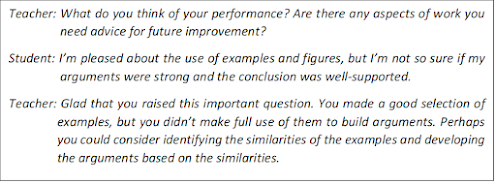
Teachers could set the scene by stating the aim of feedback discussion and setting expectations at the outset of dialogue as follows:

Example 1   Setting a scene for candid feedback discussion


Students’ anxiety about feedback discussion could be relieved if they are clear about the purpose of the discussion and could see the value of an open discussion of problems and weaknesses.

·     Co-constructing feedback with students

Feedback co-construction involves teachers and students taking mutual responsibility for crafting feedback messages. As shown in example 2 below, this could be achieved by students making their feedback requests, followed by their teacher’s response to their needs. 

Example 2 Feedback co-construction


Allowing students to articulate feedback needs would be helpful for investing their trust in feedback interaction. When they know their feedback requests are accommodated seriously by teacher, they would be more motivated to discuss their weaknesses and would be psychologically ready to accept criticisms (To, 2021). The prerequisite for feedback co-construction is students’ capability to self-assess performance and identify their own learning challenges.

·      Empathy and attentive listening

Students’ psychological safety could be enhanced if teachers demonstrate empathy and attentive listening in their response to students’ feedback requests or explanation of learning difficulties. Illustrated by example 3, a teacher could show his / her understanding of the student’s difficulties and share his / her previous learning experience in the response.

 Example 3 Demonstrating empathy and attentive listening in feedback dialogue


When students feel teacher’s sincerity, they would be more willing to discuss their learning difficulties in the conversation. The atmosphere of sincerity could be further reinforced if teachers demonstrate the sympathetic attitude in regular classroom interaction (Carless, 2013).

Strategies to develop competence trust   

Given students’ prime concern about the quality of peer feedback, competence trust could be developed through peer feedback training and a quality check on peer feedback.

·       Peer feedback training

Peer feedback training could be incorporated into pedagogical activities to increase students’ capability to make academic judgements and construct peer comments. For example, prior to peer review activities, students could grade two to three exemplars of varied quality based on their understanding of assessment criteria and write comments to justify their evaluative decisions. Then, they could exchange their evaluative judgements and reasoning with teacher in a plenary session. Through the interaction, they could notice the judgement gaps and refine their initial understanding of quality. Teachers could also discuss with students the components of effective and ineffective peer feedback and demonstrate how to transform the ineffective feedback into effective ones.

·       Quality check on peer feedback

Teacher monitoring of the effectiveness of peer feedback could be achieved by different means. Inspired by Han and Xu (2020), teachers could collect peer feedback forms at the end of peer review and provide feedback on a random selection of peer comments with the aim of mediating students’ evaluative judgements. Alternatively, teachers could streamline the monitoring process using online platforms. For instance, when students post drafts for a collaborative writing project on Wiki or Google Classroom, teachers could have access to their drafts and peer feedback and offer input to refine the quality of peer comments during task engagement (Woo et al., 2013).

In conclusion, this article has examined the role of trust in feedback processes and has outlined some strategies to foster communication trust in teacher-student feedback exchanges and competence trust in peer feedback interaction. With a richer understanding of trust in feedback engagement, educators would be in a better position to design and implement effective feedback to enhance students’ engagement.

References

Carless, D. (2006). Differing perceptions in the feedback process. Studies in Higher Education, 31(2), 219-233. https://doi.org/10.1080/03075070600572132

Carless, D. (2013). Trust and its role in facilitating dialogic feedback. In D. Boud, & E. Molloy (Eds.), Feedback in Higher and Professional Education: Understanding it and Doing it Well (pp. 90-103). London: Routledge.

Han, Y., & Xu, Y. (2020). The development of student feedback literacy: The influences of teacher feedback on peer feedback. Assessment & Evaluation in Higher Education, 45(5), 680-696. https://doi.org/10.1080/02602938.2019.1689545

Johnson, C. E., Keating, J. L., & Molloy, E. K. (2020). Psychological safety in feedback: What does it look like and how can educators work with learners to foster it?. Medical Education, 54(6), 559-570. https://doi.org/10.1111/medu.14154

Panadero, E. (2016). Is it safe? Social, interpersonal, and human effects of peer assessment: A review and future directions. In B. Gavin, &  L. Harris (Eds.), Handbook of Human and Social Conditions in Assessment (pp. 247–266). New York: Routledge.

To, J. (2021). Using learner-centred feedback design to promote students’ engagement with feedback. Higher Education Research & Development. https://doi.org/10.1080/07294360.2021.1882403

Tschannen-Moran, M. (2014). Trust Matters: Leadership for Successful Schools (2nd edition). San Francisco: Jossey Bass.

Woo, M. M., Chu, S. K. W., & Li, X. (2013). Peer-feedback and revision process in a wiki mediated collaborative writing. Educational Technology Research & Development, 61(2), 279-309. https://doi.org/10.1007/s11423-012-9285-y

Yan, Z., & Brown, G. (2017). A cyclical self-assessment process: Towards a model of how students engage in self-assessment. Assessment & Evaluation in Higher Education, 42(8), 1247–1262. https://doi.org/10.1080/ 02602938.2016.1260091


Enhancing Students’ Assessment Literacy

 by Lin Rongchan

Assessment literacy is a multidimensional concept that involves teachers, students and other stakeholders (Stiggins, 1991). More specifically, Willis et al. (2013) put forth the following definition for assessment literacy from a sociocultural lens:

“Assessment literacy is a dynamic context dependent social practice that involves teachers articulating and negotiating classroom and cultural knowledges with one another and with learners, in the initiation, development and practice of assessment to achieve the learning goals of students.” (Willis et al., 2013, p.242)

Evidently, it is not enough to just focus on teachers’ assessment literacy without considering the role of students in assessment. Student involvement in assessment practices is central to the development of students’ assessment literacy, an area that has received increasing attention from scholars (e.g., Charteris & Thomas, 2017; Davari-Torshizi & Bahraman, 2019; Deeley & Bovill, 2017; Smith et al., 2013).

In this article, I outline the rationale of involving students in assessment and discuss relevant strategies. I will also share an example of how I involved secondary school students in assessment in a poetry writing course. This example was chosen to offer an alternative context (i.e., non-academic nature) to complement the examples shared by other contributors in this issue of our bulletin.

Rationale of involving students in assessment

Our understanding of the relationship between assessment and learning has evolved over the years. In line with paradigm shifts in learning theories, assessment practices could be classified into three generations: 1) “assessing learning of what is taught”, 2) “assessing learning as individual sense-making”; 3) “assessing learning as building knowledge as part of doing things with others” (see James, 2008, pp.21-29). Tracing the role of the learner across these three generations of assessment practices, the increase in student agency and voice is evident.

As what Watkins (2005) eloquently expressed, “students are crew, not passengers” (p.35) in a classroom community. Focusing on student-driven learning, Watkins (2017) further posed a powerful question for us to reflect on: “Are learners invited and helped to: View themselves as driving the learning, contribute their own questions, strategies and explanations, choose their challenges, develop their criteria, and assess their progress?” (p. 3).

Assessment literacy is contingent on learners’ active collaboration with teachers and peers. In the 21st century classroom that values active and collaborative learning, it is paramount to involve students in assessment to ensure the congruence of students’ learning and assessment experiences as well as to empower them in their learning. Meaningful teacher-student partnership in assessment via democratic practices can foster intrinsic motivation, active engagement and deeper ways to learning, thereby increasing students’ assessment literacy (Deeley & Bovill, 2017).

Ways to involve students

One way to engage students in assessment is through feedback practices. As defined by Carless & Boud (2018), feedback is “a process through which learners make sense of information from various sources and use it to enhance their work or learning strategies” (p.1315). Through developing students’ feedback literacy, students would be able to appreciate feedback, make judgments about their own/peers’ work, manage affect and take action accordingly (Carless & Boud, 2018). There is a growing body of research in developing students’ feedback literacy (e.g., Carless & Boud, 2018; Ketonen et al., 2020; Molloy et al., 2020). Readers who are interested in this area could refer to our February 2021 issue.

From a macro perspective, student involvement in assessment could also be conceptualized based on the extent of involvement. Building on Brew’s (1999) typology, Falchikov (2005) has classified studies on self and peer assessment into three different levels. Table 1 summarizes key information mentioned in Falchikov (2005).

Table 1

Levels of Involvement

Level

Key aspect

Illustration

1

Checking knowledge, performance or skill level

Students use model answers, marking schemes, rating scales and other teacher-provided criteria.

2

Discussing and negotiating criteria

Students participate in discussions and negotiation of criteria which they subsequently use to judge their work.

3

Decision-making by students (i.e., student choices in assessment)

Students are empowered to make decision (e.g., criteria selection, weightings and scores).

At this juncture, I would like to invite you to reflect on the following questions:

  • How did/would your students respond to the related assessment practices across the three levels?
  • Which level of self- and peer-assessment is more prevalent in your current professional setting? What are the reasons behind this phenomenon?
  • What are the factors that impede us in further empowering students in assessment practices?
  • What conditions need to be created to further involve students in assessment in your respective assessment contexts? What resources would you need?

Considering that assessment is a situated practice, a good understanding of the context, including related impetuses and potential obstacles, would facilitate the planning, enactment and evaluation of student involvement in assessment.

An example: A poetry writing course  for secondary school students

As outlined above, there are different ways as to how educators could involve students in assessment to develop students’ assessment literacy. I would like to take this chance to share my endeavors in engaging secondary school students in a poetry writing course.  

As my service to the community, I have been involved in the Author-in-Residence Programme organized by the Committee to Promote Chinese Language Learning (CPCLL), Singapore, since 2012. As my understanding of assessment literacy deepens, I have been refining my course design based on the framework on patchwork texts in assessment (Trevelyan & Wilson, 2011; Winter 2003). The essence of the framework is to empower learners and promote students’ learning through a series of carefully-sequenced patches that culminate in a final integrative piece, with an intention to promote continuous and deep learning, facilitate an integrated understanding of a topic as well as stimulate self-reflection (Trevelyan & Wilson, 2011).

In the context of my 8-hour course (over 4 lessons), there was a total of five patches which led to a final integrative piece as depicted in Figure1. The relationship between each patch and the final piece can be a tight one (i.e., students could directly build on a particular patch and submit it in the final integrative piece) or a loose one (i.e., students could create new work from scratch). More specifically, for the final piece, students had to submit two poems (minimally). For this final assessment, I provided summative qualitative feedback on students’ work and had to select outstanding work to be considered for the school’s and/or programme’s publication. For students whose work were selected, they had to act on my feedback by further refining their work (if necessary) before submitting their work to the respective editorial committee.

Figure 1

Patchwork Texts in Assessment for a Poetry Writing Course

The course content built on students’ prior knowledge (i.e., content covered in their Chinese language class) such as their understanding of rhetorical devices. The entire course was conducted virtually this year due to COVID-19. Logistics-wise, a google folder was created and each student completed the various patches on their respective document to facilitate collaboration and sharing between the students. Table 2 summarizes the instructional processes and related patches.

Table 2

Enactment of patchwork texts in a poetry writing course

Lesson

Instructional processes

Patch

1

Introduction

·    The class discussed key elements of contemporary poetry.

·    Instructor guided students to appreciate and analyze interesting poetry types (e.g., shape/concrete poetry) to trigger interest.

·    Instructor emphasized the integration of meaning and form in poetry.


Patch 1

·    Each student conceptualized a shape poem and explained their choice of shape in relation to the proposed content of the poem.

·    Each student shared their conceptualization.

·    Teacher asked questions and gave verbal feedback for students’ further refinement of ideas.

2

Association of ideas

·    Teacher introduced exercise on association of ideas.

·    Based on the given prompt, students had to think of a word or a short phrase in a sequential manner till they derived at a total of eight words or phrases, including prompt provided. (An illustrative example: Sky – Blue – Sadness – Loss – Hope – Sunlight – Plants – Life) 

·    The instructor invited a few students to share what they have thought of and asked for clarification if necessary. Students could refine their string of words where appropriate.

·    Students read “Question and Answer” (by poet Xixi) which was written using a series of ideas associated with one another in a sequential manner (Zheng et al., 2005).


Patch 2

·    Students drafted their own poem based on the string of words they thought of.

·    In pairs, students gave peer feedback (written form) on their peer’s google document.

·    Instructor invited selected students to share their work. The class discussed the work presented.

·    Instructor introduced other work to further elaborate on association of ideas.


3

Rhetorical devices

·    Instructor built on students’ prior knowledge by reviewing key rhetorical devices (e.g., simile) that students have learned through discussing selected poems.

·    Instructor introduced poetry that employs antonyms and engaged students in analyzing the poems.

Patch 3

·    Each student came up with different antonyms. Students took turn to share antonyms they thought of without repeating what was already mentioned by peers.

·    Each student drafted a short poem by integrating antonyms into their work. The class discussed selected students’ work.

·    Students were encouraged to draw on what they have learned to create more poems outside of class in preparation for final submission.

Structure of poetry

·    Instructor introduced enjambment and end-stopped lines.

·    Students analyzed the lines and stanzas of poems and discussed the impact varying structures would have on the reader.

Patch 4

·    Students were given a paragraph from a prose. They were asked to organize it into lines and stanzas.

·    Selected students explained their decision.

·    Instructor asked questions and gave feedback.

·    Instructor shared alternative ways to structure the paragraph and further discussed the impact of different structural forms.

·    Students were prompted to think about the use of enjambment and end-stopped lines in their own work, while considering the use of rhyme.

·    Once again, students were encouraged to draw on what they have learned to create more poems outside of class in preparation for final submission.

4

Poetry Slam

·    Students shared their work in class.

Patch 5

·    Each student presented a complete work with the class. For this particular sharing, students could build on the patch(es) completed in class previously. Alternatively, they could create a completely new work by drawing on the skills that they learned in past lessons.

·    The class discussed peers’ work.

·    Students voted for their two favorite work written by peers for instructor’s consideration in final assessment.


Final Submission

Final Integrative Piece

·    Students were given time to further refine their work and submitted two poems from their portfolio for summative feedback.

·    Instructor to consider students’ voting results when nominating work to be included in the publication by the school and the programme respectively.

As outlined above, students were involved in the assessment to varying extent. For example:

  • Patch 2: Students worked in pairs to give peer feedback. The instructor provided feedback on selected work to further sharpen students’ thinking.
  • Patch 3 and 4: Students had the opportunity to ask one another questions to help one another in refining their thoughts.
  • Students were encouraged to create more poems outside of class (i.e., beyond the assigned tasks) across the patches in preparation for final submission. These served as blank patches for students to determine the theme and techniques independently.
  • Patch 5: Students had the opportunity to translate feedback to feedforward depending on what they chose to share in the Poetry Slam. They subsequently voted for two best poems for instructor’s consideration in the final assessment. To some extent, this reflects level 3 of student involvement as noted by Falchikov (2005).
  • Final integrative piece: Once again, students were required to translate feedback to feedforward. The final integrative piece would then entail a resubmission of past patch(es) in a more refined form. After final assessment, students again had the opportunity to act on instructor’s summative qualitative feedback by further refining their work in their submission for publications.

Through engaging learners across various patches over an extended period of time, the scope of student involvement is broadened. It is envisaged that students would refine their understanding and hone their skills in a coherent and continuous manner, thereby increasing the likelihood of them creating work of higher quality. I also hope that students enjoy continuous and deep learning as well as develop an integrated understanding of poetry writing (see Trevelyan & Wilson, 2011, on objectives of patchwork texts). For more discussion on employing patchwork texts in local contexts, please see Tan (2011) and Tan (2019).

Conclusion

In this article, I highlight the centrality of student involvement in assessment by addressing the “why” and “how”. While I adopt a practitioner-oriented perspective when discussing related ideas, it is not my intention to provide an exhaustible list of strategies or prescribe model approaches. Rather, this article serves as an introductory piece to spark conversations. Together with other contributors for the bulletin, I would love to continue this conversation with you in our post-publication conversation. (Click here to register.)

Acknowledgment

I would like to thank A/P Kelvin Tan and Dr. Tay Hui Yong for their valuable feedback on a previous draft.

Suggested citation:

Lin, R. (2021). Enhancing students’ assessment literacy. Assessment for All Learners (AfAL) Bulletin, July 2021. https://assessmentforall.blogspot.com/2021/06/enhacing-students-assessment-literacy.html

References

Carless, D. and D. Boud (2018). The development of student feedback literacy: Enabling uptake of feedback. Assessment & Evaluation in Higher Education, 43(8), 1315-1325. https://doi.org/10.1080/02602938.2018.1463354

Charteris, J., & Thomas, E. (2016). Uncovering ‘unwelcome truths’ through student voice: Teacher inquiry into agency and student assessment literacy. Teaching Education, 28(2), 162-177. http://dx.doi.org/10.1080/10476210.2016.1229291

Davari-Torshizi, M. D., & Bahraman, M. (2019). I explain, therefore I learn: Improving students’ assessment literacy and deep learning by teaching. Studies in Educational Evaluation, 61, 66–73. https://doi.org/10.1016/j.stueduc.2019.03.002

Deeley, S. J., & Bovill. C. (2017). Staff student partnership in assessment: Enhancing assessment literacy through democratic practices. Assessment & Evaluation in Higher Education, 42(3), 463-477. http://dx.doi.org/10.1080/02602938.2015.1126551

Falchikov, N. (2005). Improving assessment through student involvement: Practical solutions for aiding learning in higher and further education. Routledge. https://doi.org/10.4324/9780203220993

James, M. (2008). Assessment and learning. In S. Swaffield (Ed.), Unlocking assessment: Understanding for reflection and application (pp. 20–35). Routledge.

Ketonen, L., Nieminen, P., & Hähkiöniemi, M. (2020). The development of secondary students’ feedback literacy: Peer assessment as an intervention. The Journal of Educational Research, 113(6), 407-417. https://doi.org/10.1080/00220671.2020.1835794

Molloy, E., Boud, D., & Henderson, M. (2020). Developing a learning-centred framework for feedback literacy. Assessment and evaluation in higher education, 45(4), 527-540. https://doi.org/10.1080/02602938.2019.1667955

Smith, C. D., Worsfold, K., Davies, L., Fisher, R., & McPhail, R. (2013). Assessment literacy and student learning: The case for explicitly developing students ‘assessment literacy’. Assessment & Evaluation in Higher Education, 38(1), 44-60. http://dx.doi.org/10.1080/02602938.2011.598636

Stiggins, R. J. (1991). Assessment literacy. Phi Delta Kappan, 72, 534-539.

Tan, K. (2011). Alternative assessment in schools: A qualitative approach. Pearson.

Tan, M. (2019). Patching the gap with patchwork assessment. SingTeach, Issue 68. https://singteach.nie.edu.sg/issue68-contributions1/

Trevelyan, R., & Wilson, A. (2011): Using patchwork texts in assessment: Clarifying and categorising choices in their use, Assessment & Evaluation in Higher Education, 37(4), 487–498. https://doi.org/10.1080/02602938.2010.547928

Watkins, C. (2005). Classrooms as learning communities: What’s in it for schools. Routledge.

Watkins, C. (2017). Developing student-driven learning: The patterns, the context, and the process. In N. Alias, & J. Luaran (Eds.), Student-driven learning strategies for the 21st century classroom (pp. 1-9). IGI Global. http://doi:10.4018/978-1-5225-1689-7.ch001

Willis, J., Adie, L., & Klenowski, V. (2013). Conceptualising teachers’ assessment literacies in an era of curriculum and assessment reform. The Australian Educational Researcher, 40(2), 241-256. https://doi.org/10.1007/s13384-013-0089-9

Winter, R. 2003. Contextualizing the patchwork text: Addressing problems of coursework assessment in higher education. Innovations in Education and Teaching International, 40(2), 112–122. https://doi.org/10.1080/1470329031000088978

Zheng, Y.Z., Zhang, J.W., & Zeng, Z.C. (2005). Kuaile mishi yixia. Global Publishing. (Work in Chinese)