In Conversation with Ms. P Durka Devi, Teaching Fellow, National Institute of Education, Nanyang Technological University


Could you tell us about your background? 

I began my teaching career as a primary school teacher and held the posts of head of science department and school staff developer. Prior to joining NIE, I had a stint as a Senior Academy Officer at the Academy of Singapore Teachers. There I was involved in the design and facilitation of professional learning programmes and school-based consultation for key personnel and teachers.  

What prompted you to join NIE as a teaching fellow? What do you hope to accomplish through your stint here? 

As a doctoral student in my last lap towards the finish line, a secondment to NIE offers an excellent opportunity to not only to connect with like-minded people but also to hone my skills as a teacher educator and a researcher. Most importantly, I am in a position to impact teaching and learning through my courses which bring theory closer to the practitioner— something I worked hard at doing as a curriculum leader in school. Through my courses, I hope to engage teachers, teacher leaders and key personnel in making meaningful links between theory and practice. As a strong believer of inquiry into practice, I hope to encourage more educators to experiment with research-informed practices collaboratively and in partnership with experts and knowledgeable others.  

What are your areas of focus for your research and courses? 

At NIE, I teach pre-service, in-service, post-graduate and graduate professional learning courses. My courses focus on areas ranging from general pedagogy to leadership in assessment and feedback practices in schools. Particularly, I teach courses in effective feedback practices as this is also an area of focus for my doctoral research. My research study focuses on primary science teachers conceptions and use of formative feedback through discourse analysis. I believe that research on the practices of feedback in classroom discourse can provide a more holistic view of teacher feedback literacy. 

What are your beliefs towards assessment?  

I believe that assessment should enable learning and learners. As a student, I experienced assessment as high-stakes examinations, the results of which determined what subjects I was good at and what courses I would be offered. I remember vividly how I got a fail score for Art in lower secondary. It was the last time I attempted to draw anything with confidence. Now that I look back, perhaps I would have been motivated to try again if the assessment had been formative and if feedback had been provided. It is heartening to see a shift in the national direction towards assessment in recent years. With this shift, my hope is that teachers can use assessment as an enabler for learning instead of for the purpose of testing alone.

In Conversation with Mr. Tan Ken Jin, School Staff Developer, Bartley Secondary School

Please refer to the link below for the “In Conversation” podcast with Mr. Tan Ken Jin, School Staff Developer, Bartley Secondary School.

Link to video: In Conversation with Mr. Tan Ken Jin

Assessment Practices with Academically Low Progress Learners in a Singapore Primary School

by Mr Jerome Chong (MCT903)

Abstract

This study examines the ramifications and implications of assessment practices carried out with academically low progress learners (LPL) in a Singapore mainstream primary school. A primary 5 (P5) foundation stream class of 18 students were taught by the same teacher in English and Mathematics for 2 academic years until they sat for their Primary School Leaving Examination (PSLE) paper at the end of primary 6 (P6). This study focuses on Assessment for Learning (AfL) practices and feedback provided by the teacher, by peers of the students and through teacher supervised Technology Enabled Applications (TEA). It investigates some of the challenges faced, courses of action taken and some suggestions to improve upon the results obtained.

Introduction

There are not many studies on AfL conducted on LPL in the primary school context in Singapore. This study discusses challenges that was faced when implementing AfL practices, the resultant courses of action that were taken, some solutions that were formed and the results that were achieved with LPL in a mainstream primary school in Singapore. This paper studies actual classroom examples of the class’ journey with the same teacher who was their Form, Foundation Level English (FEL) and Foundation Level Math (FMA) teacher for 2 years from P5 to P6 in the class of (initially) 18 LPL students who were banded in the Foundation stream at the beginning of P5 to “help them build strong fundamentals, and to give them the confidence to pursue learning at a pace and level that is more suited to them” (MOE, 2019). These students were placed in the foundation class as they had not been able to catch up with the syllabus from P1 to P4. Most had consistently fallen in the bottom 10% of the cohort in terms of overall academic results in the years prior to P5. However, the students in this study had improved their results with FEL passes increasing from 56% of the class passing at the P5 entry point, to 95% passing at the P6 year-end exams prior to the PSLE and FMA passes increasing from 6% at the beginning of P5, to 95% at P6.

Statistics by the Research and Management Information Division (2018) indicate that there are an average of 39,000 students in each cohort, of these about 4,000 (10% of cohort) offer FEL and/ or FMA at PSLE. The primary school in this study has students offering FEL and FMA figures similar to national statistics with 13% of its cohort offering these. LPL students are defined as “the 15–20% lowest academic scorers” in standardised examinations in the Singapore context (Wang, Teng & Tan, 2014). 

Based on an ethnographic study of students in the Normal-Technical (NT) stream in a Singapore secondary school, the (NT) students had traits of ‘average’ self-esteem and academic achievement and poor study habits that worsened as they went on to Secondary 2. They possessed poor command of English and attention span and preferred less ‘critical’ and more ‘flexible’ teachers; their low literacy levels also compounded classroom management problems (Ismail & Tan, 2005). Another study found that students in the NT stream in secondary school are assumed to have poor behaviour, possess poor study habits and have low motivation and self-esteem. (Talib & de Roock, 2018). Similarly, in the primary school context, it was observed that LPL are from “low-income families who rarely use English as the medium of communication” (Wang et al, 2017). Most of the LPL’s academic success “intersect with other factors including poverty, racial or linguistic minority and learners are also identified as having special education needs (SEN)” (Kang & Martin, 2018).  Students with SEN have “starting points often lower than those of other pupils” (Colum & McIntyre, 2019). Based on the past records of the primary school being studied, most of its LPL and foundation students end up in the NT stream in secondary school. The LPL in this class fit into the above descriptions with various family, personal or societal related issues. These are analysed at the class level and tabulated below:

It was surmised that LPL students have low achievement traits due to the levels of (1) Individual, (2) School/ education system and (3) Family and society. It was suggested that strategies to mitigate low achievement traits should target these three levels (Wang, Teng & Tan, 2014). Some strategies include “promoting mastery goal and growth-mindset and (by) providing effective feedback” (Talib & de Roock, 2018). The teacher in this study attributes much of the improvement in the students’ overall improved results to feedback and AfL practices that were implemented; Tan succinctly surmises that literature on formative assessment (FA) has three recurring emphases, one of them being “giving feedback that enables them (students) to improve their work” (Tan, 2013). AfL was defined as the “part of everyday practice by students, teachers and peers that seeks, reflects upon and responds to information from dialogue, demonstration and observation in ways that enhance ongoing learning” (Klenowski, 2009). This paper continues by demonstrating how effective feedback and AfL practices based on the two definitions above was used in this classroom had posed some challenges, how these were addressed and some solutions that were adopted. All names of students have been changed.

Teacher-led Feedback… of AfL, feedback, power and the curriculum, 

Tan (2013) presented a simplified model for AfL, where assessment standards was represented by the vertical axis, task design by the horizontal axis, and feedback practices by the incline, forming a “triangle of practices.” (Tan, 2013). In this class, the teacher had a clear understanding of each student’s background based on the three levels to mitigate low achievement (Wang, Teng & Tan, 2014). The teacher firstly set an assessment standard to be achieved by each student, before designing and timing the feedback to be given. This then had to be interpreted and applied by the learner and to be re-given as necessary. 

About half of the class had failed English at entry point at P5 and by the end of 2019, all but the student with GDD had passed. The three students presented here are Terry, diagnosed with dyslexia, communicates in English at home with mum and siblings and in Mandarin with father and grandparents. Harshita, is a conscientious student who communicates mainly in Tamil with parents at home. Salman, diagnosed with ADHD, has several internal disciplinary cases and communicates well in English. Below is a sample of the students’ work on a continuous writing (CW) assignment where they were required to write the introduction of the CW based on the first picture of a CW assignment for the FEL stream.


By being cognizant about each student’s standards to achieve and with a clear AfL design, the teacher provided appropriate and timely feedback catered to each student to meet their individual gaps in learning, the dialogic practice between the teacher and student then completed the “triangle of practices” (Tan, 2013) for the 3 students. This can be clearly represented and compared in Figure 5 as shown:


It was also important to note that in the practice of feedback and dialogue with the student, the teacher had also built strong teacher student relationship (TSR). This is a “significant predictor of students’ academic engagement”. High quality TSR correlates with “self-esteem, level of competency and emotional connection”.  (Talib & de Roock, 2018).

Peer led AfL / feedback… of AfL, feedback, power and Social Justice

The last day/ session of the Sexuality Education (SEd) series for the P6s involved separating the boys from the girls in the P6 cohort to allow the teacher to conduct more gender-directed lessons. The teacher had a combined class of the LPL boys from Class 6H with the boys from Class 6G which is the school’s banded class (achieving the top 20% academic scores from P4 for the cohort and taking all subjects at the Standard level). The boys were reminded about the SEd lessons learned from a comic strip they had gone through 3 days prior, depicting the friendship of Roslin, Sue Ann and Gina when they were still in their respective classes. The boys were then grouped into smaller groups of mixed 6H/ 6G boys. Without the girls in the class, the boys felt more at ease and were allowed to ‘buzz’ and give each other feedback in their groups before presenting their thoughts to the class as a whole.

“The overarching principle of both relying on and providing instrumental peer support through shared inquiry, facilitates the development of original insights and discoveries” (Talib & de Roock, 2018). It was interesting to see how the boys from 6H and 6G interacted and built on each other’s feedback to come up and present what they thought about Sue Ann and Gina as Roslin’s friends. They used terms that each group may not have understood, as the 6H boys taught the 6G boys new colloquialisms.  It was also clear to see that most of the 6H boys had more real life experiences and ‘street-smarts’ than the 6G boys. The 6H boys led a lot of the discussion and seemed to have imparted a lot of knowledge to the 6G boys at the end of the lesson.


Many of the boys from 6H come from very challenging backgrounds. The reality is that they face real and tough problems compared to the 6G boys who are mostly from relatively sheltered and intact middle income families, with none falling in the discipline problem, FAS or SEN brackets. It demonstrated that when given an opportunity, there was rich cross learning to be had between peers, even when one is seemingly less ‘academically endowed’. Indeed much of the benefits of peer feedback and cooperative learning, such as improving academic achievement in a supportive and secure learning environment, improving relationships between peers and improving self-actualisation (Crawford, 1995) were clearly attained in this unusual setting of very disparate learning abilities, SES, behaviour and motivations.

The lesson also demonstrated the differences in equality that we are facing in our schools. However, it was heartening to note that in this exercise, peer feedback and assessment offered “equal classroom opportunities”, resulting in improved “self-efficacy” and “deeper learning” (Oakes, 1985) for the boys from both classes. 

When we engage students from different family backgrounds, SES and learning abilities in one class, the initial differences can be very stark, but in this classroom, there was a levelling of the playing field, where for a fleeting moment, the “power to make choices to disproportionately shape outcomes and limit options for people who don't have the power to make choices” (Teo, 2018b) was temporarily switched off, thereby creating a system that “truly serves the needs of all” (Teo, 2018a).

Technology Enabled Assessment / Feedback… of AfL, feedback and ethics

In a local study, it was concluded that the use of iPads was “associated with greater learner engagement and collaboration, the differentiated effect was enjoyed at both cohort and ability grouping and that teachers should harness technology to develop students’ ability to take charge of their learning, thus resulting in deeper learning” (Tay, 2016). This was followed by the launching of the Singapore Student Learning Space (SLS) by the MOE in 2018 to “encourage learners to be self-directed, to work collaboratively with peers, to engage in interactive resources and to learn according to their needs and interests” (MOE, 2017).

In this classroom, the students gained some success in using technology in their learning. Timmis et al (2015) highlighted some opportunities afforded by Technology Enhanced Assessment (TEA); of interest being enhancing feedback to students by recognising the “importance of students in giving, as well as receiving feedback and to encourage students to act upon this as a means of sustaining learning in schools”.


Elliot’s comments on technology enhanced learning ranged from, “I like it because it’s exciting and it is fun” and “I can learn when it tells me where I am going wrong when I keep practicing it”. Malani’s thoughts included preferring the Kahoot game over other methods such as the Flash cards game and written quizzes, because it was fun, that she knows the answers and she gets to learn. A short interview (MP4 file) with her can be accessed in this link.
 
Elliot comes from a middle income background and has been diagnosed with ODD and ADHD. Elliot has no screen time limits imposed at home and admits that his ‘record’ was 20 hours gaming non-stop online. Malani resides in a Foster care home, has been diagnosed with dyslexia and has on record, various offences committed in school and at the Foster home. She has very little online privileges other than those offered by the teacher in school. Elliot has performed consistently better in all his subjects and his scores both online and his FMA exam had shown marked improvement of over 30% whilst Malani had only a 10% improvement in comparison. We thus see problems such as the risk of social exclusion associated with TEA and that TEA may not always be fair and equitable due to each students’ circumstances (Timmis et al, 2016).
 
It has been argued that technology can identify who needs to be differentiated and helps with the provision for the differentiation in the best case scenario, but technology also creates artificial ‘barriers’ and perpetuates the wrong things. It may accentuate the unequalness of it all and TEA may become a form of discrimination (Munshi & Deneen, 2018). We need to question between the Socio and Economic realities versus the Educational imperatives. Assessment in all its forms is a powerful educational practice and if it is enhanced by technology, which side does it go for?

Feedback on the teacher, turning the tables... AfL, power, social justice, rubrics

In an often neglected area when AfL is discussed, the teacher being assessed on whether he has taught and performed well holistically as a teacher through feedback given to him by his students is often not done. This is important as much can be learned from an honest and open dialogue with his students. From here, it would also convey the teacher’s confidence and trust in their students’ abilities, thereby overcoming any form of deficit thinking perceived about them (Talib & de Roock, 2018).


On a systemic front, research has also found evidence that when there is more equitable deployment of teachers with more experience with LPL and ‘better’ perceived qualities by students being assigned to the LPL groups, there will be an accompanying improvement in self-confidence and to bridge the gap of the LPL being disadvantaged socially. There is also a decrease in the occurrence of (negative) self-fulfillment prophecy of LPL that they are doomed to a “cap on learning and limitation to the development of skills” (Francis et al, 2018). It is heartening to note that in this and several other Singapore primary schools, HODs and Senior Teachers are now increasingly being assigned to LPL or foundation level subject classes, often bringing along experience and innovative teaching methods that seeks to uplift LPL. This then answers the conversations and solutions that we need to have about social selection, equality and social justice (Dunne et al, 2011).

Conclusion

It stands that AfL (and feedback) is a powerful tool when engaging with LPL. Feedback must be dialogic in whatever form it is employed, be they, teacher or peer directed, or technology enabled. By receiving feedback on themselves, teachers can reflect on their weaknesses and strengths. On the systemic front, there must be the “capacity or willingness of the school to accept, accommodate, and respond to them (LPL) in a manner that supports and enables their maximum social, emotional, and intellectual growth and development” through knowing the students’ backgrounds to plan and enact realistic curriculum, pedagogies and expectations (Ismail & Tan, 2005). 

As educators, can we be advocates, be more vulnerable, to walk in the shoes of the LPL, to understand their cultures, backgrounds and needs, and to respect these by giving these children enough ‘chances’ for them to get things ‘right’? Do we also, on a systemic front do enough to enhance teacher efficacy, knowledge, recruitment and personal development so that it becomes more student centric (Wang et al, 2017). Finally, we have also seen that inequality in the class can be detrimental to the children on many fronts. Some pressing reflection may be in order to wonder if we have the right people in all strata of education to make the correct decisions and to work towards these to provide equitable opportunities for our LPL to learn (Sadler, 2007) to their fullest potential. 

References

  • Alderton, J. & Gifford, S. (2018). Teaching mathematics to lower attainers: dilemmas and discourses. Research in mathematics education, 2018. Vol. 20, No. 1, 53-69.
  • Cheng, Y.S., Leong, W.S., and Tan, K. H. K. (2015). Assessment Rubrics for Learning. Assessment and Learning in Schools. Singapore: Pearson Education South Asia Pte Ltd.
  • Chong, W. H., Huan, V. S., Quek, C. L., Yeo, L. S., & Ang, R. P. (2010). Teacher-student relationship: The influence of teacher interpersonal behaviours and perceived beliefs about teachers on the school adjustment of low achieving students in Asian middle schools. School Psychology International, 31(3), 312–328.
  • Cizek, G.J. (2009). An introduction to formative assessment- History, characteristics and challenges. Handbook of formative assessment. Great Britain: Routledge Ltd, 3-17.
  • Colum, M. & McIntyre, K. (2019). Exploring Social Inclusion as a Factor for the Academic Achievement of Students Presenting with Special Educational Needs (SEN) in Schools: A Literature Review. REACH Journal of Special Needs Education in Ireland, Vol. 32.1 (2019), 21–32.
  • Crawford, L. (1995). Cooperative Learning in Singapore Primary Schools: Time for Reflection. Teaching and Learning, 16(1), 12-16.
  • Dickson, J. (2011) Humiltas. Michigan: Zondervan.
  • Dunne, M., Humphreys, S., Dyson, A., Sebba, Gallannaugh, F. & Muijs, D. (2011). The teaching and learning of pupils in low-attainment sets. The Curriculum Journal, Vol. 22, No. 4, December 2011, 485–513.
  • Ee, L.L. & Joseph, J. (2011). Paving the Fourth Way: The Singapore Story. Singapore, National Institute of Education.
  • Francis, B., Hodgen, J., Craig, N., Taylor, B., Archer, L., Mazenod, A., Tereshchenko, A. & Connolly, P. (2018). Teacher ‘quality’ and attainment grouping: The role of within-school teacher deployment in social and educational inequality. Teaching and Teacher Education 77 (2019), 183 -192. 
  • Gopinathan, S. (2012). Fourth Way in action? The evolution of Singapore’s education system. Educational Research for Policy and Practice. New York: Kluwe (Issue 11:1, pp. 65-70).
  • Hargreaves, A., & Shirley, D. (2009). The fourth way: The inspiring future for educational change. Thousand Oaks, CA: Corwin.
  • Hattie, J. & Timperley, H. (2007). The power of feedback. Review of Educational Research, 77(1), 81–112. 
  • Ismail, M. & Tan, A.L. (2005).  Voices from the Normal Technical World- An ethnographic study of low-track students in Singapore. Singapore, National Institute of Education, Centre for Research in Pedagogy and Practice.
  • Kane, M. T. (2001). Current concerns in validity theory. Journal of Educational Measurement, 38(4), 319-342.
  • Kang, D.Y. & Martin, S.N. (2018) Improving learning opportunities for special education needs (SEN) students by engaging pre-service science teachers in an informal experiential learning course, Asia Pacific Journal of Education, 38:3, 319-347.
  • Klenowski, V. (2009). Assessment for Learning revisited: an Asia-Pacific perspective. Assessment in Education: Principles, Policy & Practice, 16: 3, 263 – 268.
  • Klenowski, V. (2015). "Fair Assessment as Social Practice." Assessment Matters 8: 76 - 93.
  • MOE, Singapore (2017). PRESS RELEASES- Nurturing Future-Ready Learners - Empowering Students in Self-Directed Learning. Retrieved from https://www.moe.gov.sg/news/press-releases/nurturing-future-ready-learners---empowering-students-in-self-directed-learning .
  • MOE, Singapore (2018). PRESS RELEASES- 'Learn For Life’ – Preparing Our Students To Excel Beyond Exam Results. Retrieved from https://www.moe.gov.sg/news/press-releases/-learn-for-life---preparing-our-students-to-excel-beyond-exam-results .
  • MOE, Singapore. (2019a). Learn For Life – Remaking Pathways- Greater Flexibility With Full Subject-Based Banding. Retrieved March 20, 2019, from https://www.moe.gov.sg/news/press-releases/learn-for-life--remaking-pathways--greater-flexibility-with-full-subject-based-banding .
  • MOE, Singapore. (2019b). Updates to PSLE 2021 Scoring System – Enabling Students to Progress, Regardless of Starting Points. Retrieved on 10 Nov 2019 from https://www.moe.gov.sg/news/press-releases/updates-to-psle-2021-scoring-system--enabling-students-to-progress--regardless-of-starting-points .
  • Munshi, C. and C. Deneen (2018). Self-regulated Learning and the role of Feedback. Cambridge Handbook of Instructional Feedback. A. A. Lipnevich and J. K. Smith.
  • Oakes, J. (1985). Keeping track: how schools structure inequality. London: Yale University Press.
  • Ong, Y.K. (2018). Helping Singapore's students to learn for life. Retrieved from https://www.todayonline.com/commentary/helping-singaporean-students-learn-life .
  • Parkin, H., Hepplestone, S., Holden, G., Irwin, B., & Thorpe, L. (2011). A role for technology in enhancing students’ engagement with feedback. Assessment & Evaluation in Higher Education, Electronic First Edition.
  • Ratnam-Lim, C.T.L. & Tan, K.H.K. (2015). Large-scale implementation of formative assessment practices in an examination-oriented culture. Assessment in Education: Principles, Policy & Practice. Vol. 22, No. 1, 61–78, http://dx.doi.org/10.1080/0969594X.2014.1001319.
  • Research and Management Information Division (2018). Education Statistics Digest. Singapore, Management Information Branch, Ministry of Education.
  • Sadler, D. R. (2007). Perils in the meticulous specification of goals and assessment criteria. Assessment in Education, 14(3), 387 - 392.
  • Sahlberg, P. (2011). Finnish lessons: what can the world learn from educational change in Finland? New York: Teachers College.
  • Stodberg, U. (2011). A research review of e-assessment. Assessment & Evaluation in Higher Education, Electronic First Edition.
  • Talib, N. & de Roock, R. (2018). Motivation Strategies for Academically Low-Progress Learners. NIE Working Paper Series No. 12, Singapore, Office of Education Research, NIE/NTU.
  • Tan, K. (2013). A Framework for Assessment for Learning: Implications for Feedback Practices within and beyond the Gap. ISRN Education, Vol 2013, Article ID 640609.
  • Tan, K.H.K. (2016). Asking questions of (what) assessment (should do) for learning: the case of bite-sized assessment for learning in Singapore. Educational Research for Policy and Practice, 16(2), 189-202.
  • Tan, K. H. K. and H. M. Wong (2018). Assessment Feedback in Primary Schools in Singapore and Beyond.  . The Cambridge Handbook of Instructional Feedback.  UK, Cambridge: Cambridge University Press.
  • Tay, H. Y. (2016). Longitudinal study on impact of iPad use on teaching and learning. Cogent Education, 3(1), 1-22.
  • Tay, H, Y. (2017). A prototype twenty-first century class: a school-wide initiative to engage the digital native. In S. Choo, D. Sawch, A. Villanueva, R. Vinz (Eds.), Educating for the 21st Century.  Springer.
  • The Straits Times (2018). Changes to school assessment: What you need to know. Retrieved from https://www.straitstimes.com/singapore/education/changes-to-school-assessment-what-you-need-to-know.
  • Timmis, S., Broadfoot, P., Sutherland, R., & Oldfield, A. (2015). Rethinking assessment in a digital age: opportunities, challenges and risks. British Educational Research Journal, 42.
  • Wang, L.Y., Teng, S.S. & Tan, C.S. (2014). Levelling Up Academically Low Progress Students in Singapore. NIE Working Paper Series No. 3, Singapore, Office of Education Research, NIE/NTU.
  • Wang, L., Tan, L., Li, J., Tan, I. & Lim, X. (2017). A qualitative inquiry on sources of teacher efficacy in teaching low-achieving students. The Journal of Educational Research 2017, Vol. 110, No. 2, 140 – 150. 
  • Watson, A. (2002). Instances of mathematical thinking among low attaining students in an ordinary secondary classroom. Journal of Mathematical Behavior,  20 (2002) 461–475 .
  • Teo, Y. Y. (2018a). This is what inequality looks like. Singapore: Ethos Books.
  • Teo, Y. Y. (2018b). When kids say "I lazy what". The Straits Times. Retrieved from https://www.straitstimes.com/opinion/when-kids-say-i-lazy-what.

Recommended Publications

Please refer to below for some new assessment publications that we would like to bring to your attention:

Boud, D. & Dawson, P. (2021) What feedback literate teachers do: an empirically-derived competency framework, Assessment & Evaluation in Higher Education, DOI: 10.1080/02602938.2021.1910928

If feedback is to be conducted effectively, then there needs to be clarity about what is involved and what is necessary for teachers to be able to undertake it well. While much attention has recently been devoted to student feedback literacy, less has been given to what is required of teaching staff in their various roles in feedback processes. This paper seeks to elucidate teacher feedback literacy through an analysis of the accounts of those who do feedback well. An inductive analysis was undertaken of conversations about feedback with 62 university teachers from five Australian universities using a dataset of transcripts of interviews and focus groups from two earlier research studies. Through an iterative process a teacher feedback literacy competency framework was developed which represents the competencies required of university teachers able to design and enact effective feedback processes. The paper discusses the different competencies required of those with different levels of responsibility, from overall course design to commenting on students’ work. It concludes by considering implications for the professional development of university teachers in the area of feedback.

Chan, K.T., Tan, K. How teachers experience assessment tension and its effect on formative assessment practices. Educ Res Policy Prac (2022). https://doi.org/10.1007/s10671-022-09316-1

Formative assessment (FA) has been a popular discourse in education, but its potential benefit is fundamentally dependent on teachers’ willingness to make changes to their classroom practices. These changes bring about much assessment tension (AT). This paper argues that how well teachers experience and manage AT determines the efficacy of their FA practices. Past studies have warned that AT experienced by teachers is complex and problematic. Therefore, it would be useful to investigate the variation of AT experienced by teachers, and how well they are dealing with these tensions. This phenomenographic research examines the use of FA in the context of different ways that AT is experienced. Findings on teachers’ conceptions of AT are presented, and each is then discussed for insights into teachers’ meanings and practices of assessment. In particular, instances of how AT hindered or helped FA are identified to highlight more productive ways of understanding and using assessment to support students’ learning. Implications of the research findings for the Singapore Teaching Practice (STP) will be discussed.

Tan, K.H.K. (2022). Assessment Reforms in Singapore. In Lee, Y.J. (Ed.), Education in Singapore: People making and Nation building (pp. 243-260). Singapore : Springer.

The education system in Singapore has been transformed since its independence from colonial British rule in 1965. Reforms have occurred in four distinct phases: the survival phase; the efficiency phase; the ability-driven phase, and currently its values driven and student centredness phase. Each phase of education has been supported and driven by corresponding assessment reform. In the past few years, there has been a distinct effort to shift assessment purposes and discourse away from high stakes testing for placement and stratification, towards using assessment to signal and support learning within and beyond schools. Three assessment reforms are examined in this chapter – the reduction in emphasis on examinations in primary schools in 2008, the shift away from norm referenced assessment in the high stakes national examination for primary students (announced in 2016), and the changes to assessment and streaming in secondary schools announced in 2018. These reforms demonstrate the tight alignment between policy making and school implementation, and offers insights into the complexities in grappling with tensions between maintaining rigour and control in high stakes summative assessment against transparency of assessment standards for use in formative assessment in schools.

Tay, H.Y., Lam, K.W.L. Students’ engagement across a typology of teacher feedback practices. Educ Res Policy Prac (2022). https://doi.org/10.1007/s10671-022-09315-2

The provision of feedback is widely practised as part of formative assessment. However, studies that examine the impact of feedback are usually from the teachers’ perspective, focusing on why and how they provide feedback. Fewer studies examine feedback from the students’ perspective, especially in the way they experience, make sense of and take up their teachers’ feedback. This paper provides empirical evidence of student engagement with different patterns of teacher feedback in their written essays. Data were gathered from 45 students (from 5 different schools) through group interviews and analysis of student artefacts from three rounds of writing tasks. The findings on affective, behavioural and cognitive engagement surfaced the conditions that will contribute to students’ will and skill to act on their teachers’ feedback. The implications on both teacher and student assessment literacy are discussed. The discussion will provide professional development providers and policy makers with new perspectives of and approaches to strengthening formative assessment practices in ways that are more cognizant of students’ experience of feedback.

Panadero, E., & Lipnevich, A.. (2021). A review of feedback typologies and models: Towards an integrative model of feedback elements. Educational Research Review. 35. 100416. 10.1016/j.edurev.2021.100416. 

A number of models has been proposed to describe various types of feedback along with mechanisms through which feedback may improve student performance and learning. We selected fourteen most prominent models, which we discussed in two complementary reviews. In the first part (Lipnevich & Panadero, 2021) we described the models, feedback definitions, and the empirical evidence supporting them, whereas in the present publication, we analyzed and compared the fourteen models with the goal to classify and integrate shared elements into a new comprehensive model. As a result of our synthesis, we offered an expanded typology of feedback and a classification of models into five thematic areas: descriptive, internal processing, interactional, pedagogical, and students characteristics. We concluded with an Integrative Model of Feedback Elements that includes five components: Message, Implementation, Student, Context, and Agents (MISCA). We described each element and relations among them, offering future directions for theory and practice.

Carless, D., & Winstone, N. (2020) Teacher feedback literacy and its interplay with student feedback literacy, Teaching in Higher Education, DOI: 10.1080/13562517.2020.1782372 

Feedback processes are difficult to manage, and the accumulated frustrations of teachers and students inhibit the learning potential of feedback. In this conceptual paper, challenges to the development of effective feedback processes are reviewed and a new framework for teacher feedback literacy is proposed. The framework comprises three dimensions: a design dimension focuses on designing feedback processes for student uptake and enabling student evaluative judgment; a relational dimension represents the interpersonal side of feedback exchanges; and a pragmatic dimension addresses how teachers manage the compromises inherent in disciplinary and institutional feedback practices. Implications discuss the need for partnership approaches to feedback predicated on shared responsibilities between teachers and students, and the interplay between teacher and student feedback literacy. Key recommendations for practice are suggested within the design, relational and pragmatic dimensions. Avenues for further research are proposed, including how teacher and student feedback literacy might be developed in tandem.

Sadler, I., Reimann, N., & Sambell, K. (2022) Feedforward practices: a systematic review of the literature, Assessment & Evaluation in Higher Education, DOI: 10.1080/02602938.2022.2073434

The notion of ‘feedforward’ has emerged as popular with practitioners, and there has been an upsurge in publications which include this term. This interpretivist and conceptual systematic review sought to consider the different forms of educational practices that are framed in relation to feedforward. The initial search of four electronic databases found 1076 articles published between 2007 and 2019, which were reduced to 68 once duplicates had been removed and exclusion/inclusion criteria applied during screening and eligibility procedures. An iterative meta-ethnographic approach to analysis resulted in the identification of five main practices, framed as feedforward. These were: alignment and timing (41%); use (25%); comments (18%); self-review (9%); and teaching (7%). The vast majority involved a process where student improvement was a key goal, but the design of this process differed between practices. A large proportion supported improvement from one task to the next, almost exclusively within the ‘future horizon’ of the module/study unit, while only a small proportion of articles focuses on improving the amount, nature or quality of the information delivered to learners. Evidence of student sense-making and uptake was rarely sought, and few practices offered genuine opportunities for student agency, self-regulation and the development of evaluative judgment.

Editorial Note

Trust is an essential component of an effective functioning society. At the macro level, we trust the judicial system to mete out fair justice to criminal perpetrators. At the micro level, we trust in the integrity of other individuals whenever we purchase a product. In education, we place trust in the pedagogical efficacies of teachers and the curriculum knowledge of specialists. It is no different in the assessments that are administered. We trust that national examinations are successful in student placements and that the formative assessments we design would be able to sieve out learning difficulties of students. Certainly, regardless of purpose and design, the effectiveness of an assessment is proportional to the amount of trust that assessors and stakeholders place in it.

This issue will explore the roles and impact of trust in assessments. It begins in the Focus section where trust in both summative and formative assessments are examined. The impacts of (dis)trust in these assessments as well as approaches to enhance trust are gleaned from literature to provide the reader with a concise view of these issues. Following that, Dr Jessica To discusses the role of trust in feedback engagement. Strategies that can develop communication and competence trust in feedback processes are suggested for educators.

In the Featured section, we present how teachers’ and students’ trust in assessment can produce results. Shynn Lim and Maybellina Lim reflect how the social-emotional competencies of students in Juying Secondary School are enhanced through dialogic feedback and meaningful talk. They share the means in which teachers leverage on a social-emotional assessment tool (SEC Inventory) to increase the effectiveness of the approach. Next, a team of senior teachers in chemistry from five different schools illustrate how they co-designed a peer review workshop to enable student feedback literacy. Steven Wong, David Loh, Yew Kai Long, Tan Keng Hsin and Loy Hui Chun describe the provision of peer feedback in their chemistry lessons and how it has impacted students. Finally, a team of teachers from Riverside Secondary School share an ongoing science assessment journey undertaken by the school to develop students’ independence in learning. Fung Eng Chu, Tan Xing Yu, Tan Thiam Soon and Lee Min Huey elaborate on the various approaches that were implemented. When teachers and students trust the value of their assessments, change will ensue and learner outcomes will follow.

Can we trust students to shape education positively? In the Noteworthy Assignments section, a team of participants in the Leaders in Education program believe that tapping into student voice has the potential to amplify learning. Benjamin Quek, Ho Hil May, Leow Yen Ming, Martin Chan, and Nurazian Bajuri share an online platform in which they advocate for entrusting student voice. Next, Suja and Xinlin from the MTeach program examines their own AFL practices for primary one students. To conclude for this section, Han Zi Rui from the Management and Leadership in Schools program reflects on changing perceptions of assessment in schools.

In this issue, we are happy to be able to interview two of our long-time editorial board members, Sheree Kuek and Dr Rachel Goh as they share their personal assessment journeys. Sheree is currently the principal of Choa Chu Kang Primary School whilst Rachel is a teaching fellow in NIE who will be rejoining MOE/ELIS in 2022. Their involvement in the bulletin has undoubtedly enriched our dialogues and we leave it to the reader to read through the conversations in the News section. At the same time, we would also like to take this opportunity to welcome two new editorial board members into our executive committee: Lee Peck Ping and Devi Durka. Peck Ping is the current principal of Edgefield Secondary School and Devi will be joining the National Institute of Education as a Teaching Fellow. We will get to know more about them in the later issues of the bulletin.

Last, we are interested in involving you, our readers, to connect with us in discussing matters raised in this issue. Do join us at our post-publication conversation on 18 March 2022 (Friday), 3pm-4pm. If you are interested in joining us, please click here to register.

With that, I leave you to enjoy this issue.


Cheers,

Kah Loong


Trusting Assessments in Schools

by Chue Kah Loong, NIE

Assessment in education covers a wide field of different topics. Researchers expound on the benefits of formative assessment and explore the intricacies of feedback models. At the same time, other researchers investigate ways to tighten the rigor on summative assessments and debate the merits of standardised assessments. Regardless of the research areas involved, one underlying aim of these studies is the endeavour for more effective assessment practices. Yet, many of these studies tend to neglect one foundational mechanism that drives the efficacy of these practices. This mechanism is trust.

One of the most often cited definition of trust in literature is provided by Mayer et al. (1995), who proposed that trust is “the willingness of a party to be vulnerable to the actions of another party based on the expectation that the other will perform a particular action important to the trustor, irrespective of the ability to monitor or control that other part”. In the context of assessment, this implies that an individual has made a choice to take the risk of being evaluated by another party of individuals. This other party may be people involved in an assessment system (e.g. summative assessments) or people that have direct contact with the individual (e.g. teacher-student or student-student).

The impact of (dis)trust in school assessments

High levels of trust tend to increase efficiency by reducing costs and increasing output (Pierre & Rothstein, 2016). In this instance, high levels of trust in assessment may increase positive student outcomes and reduce efforts invested by students, teachers or school administrators. But what does it mean to trust assessment? Researchers have suggested that this refers to having confidence that:

  • the assessment is developed and administered in a professional manner (Carless, 2009; Hoey & Nault, 2002)
  • appropriate actions are taken with respect to the data generated (Hoey & Nault, 2002; Leighton & Bustos Gómez, 2018)

These two aspects of trust stretch across all forms of assessments that are conducted in schools. In summative assessments (e.g. end of year examinations, portfolios), knowledge and skills assessed need to be representative of their learning and pegged at an appropriate level of difficulty. Data generated from the results aid in determining whether the student is sufficiently competent for advancement or evaluating the effectiveness of instructional programs. In formative assessments (e.g. probing questions, homework, peer assessments), teachers need to provide feedback in a manner so that students can benefit from the feedback. Data from formative assessments are usually solely evaluated by the teacher and provide the necessary information to adjust teaching and learning processes.

Low levels of trust in assessments are likely to result in negative outcomes. Specifically, a distrust in assessments may be reflected in lower student motivation and lower risk-taking behaviours (Hoey & Nault, 2002; Knight, 2002; Carless, 2009). Table 1 illustrates some examples of sources of distrust that may cause such outcomes.

Table 1

Sources of distrust in assessments

Motivational issues can arise from assessment tasks that are consistently set at a higher difficulty level than what was expected in the curriculum or assessment scores that are consistently biased (Finn, 2015). Whilst it may seem reasonable to set a few difficult questions in each assessment task to differentiate students’ ability levels, teachers may want to consider the students’ perceptions of the interpretations of the assessment scores. If there are a number of difficult questions, students may perceive that the scores are norm-referenced (i.e. to rank the students) instead of criterion-referenced (i.e. to assess achievement level). This may run counter to the aim of getting students to learn from their errors and work towards mastery of the subject. Lower motivation

Assessment scores that are consistently biased may occur in subjects where there are higher levels of subjectivity in the grading. Many of these subjects would doubtless use essays as a means to assess higher order thought processes, but marking essays are extremely susceptible to many forms on inconsistencies (Fleming, 1999), such as differing expectations between teachers or sub-conscious biasness within a teacher. The lack of trust in the above two instances is often surfaced through maladaptive behaviours as students may deem it futile to prepare for the assessment and focus their efforts elsewhere.

Lower risk-taking

Teachers and students may end up taking less “risk” when inappropriate actions or decisions are made with regards to the information gathered from assessments (Winstone & Carless, 2021). When designing assessment tasks or setting examination questions, teachers need to be certain that the data collected from the assessment would have no adverse impact on themselves. For example, if students’ grades were used as a gauge of teacher performance, teachers may fear appearing incompetent in the eyes of their colleagues or to the school management. Working under such fear-based environments may cause teachers to set “safe” questions instead of meaningful questions to assess learning. At the same time, teachers may end up using a surface learning approach in their lessons, that is getting students to memorize answers for the assessments, instead of focusing on understanding and application (Knight, 2002).

For formative assessments to be effective, students have to take the risk of appearing incompetent by divulging any misconceptions to teachers or their peers (Carless, 2009). When the subsequent actions of the teacher do not match the interpretations of the data obtained, this will likely result in students discounting any form of feedback. Students may end up ‘faking good’ (Carless, 2009), that is to say presenting themselves as knowing more than their actual ability. Teachers may want to consider that the trustworthiness of their actions is dependent on perceptions of competency and integrity (Davis & Dargusch, 2015). Students need to be confident that teachers or peers have a minimum level of disciplinary knowledge and have acted in their best interests.

Enhancing trust in school assessments

Two possible strategies to minimize the negative impact of distrust and that can be implemented by teachers are outlined here, namely creating transparency in the assessment process and facilitating collaboration between teachers and students. Nonetheless, educators should be aware that building trust is not a once-off process, but a continuous process.

First, transparency breeds trust (Carless, 2009). Communicating to students (and parents) the thoughts behind certain assessment processes not only develops trust, it also helps students in pinpointing their weaknesses and setting goals for improvement. For example, teachers could share with students how items in an examination are calibrated to assess different levels of cognitive learning, thus providing students with confidence that the examinations are set at a fair level of difficulty. Furthermore, teachers could communicate the marking process to students, such as the allocation of marks or interpretations of rubrics. This could identify the limitations in students’ work and may give a clearer picture of the performance levels required to excel.

Furthermore, significant changes to the assessment system or processes are additional arguments for transparency. Modifications to summative assessments can occur with the inclusion of addition elements such as performance assessments or portfolios. Likewise, modifications to formative assessments can occur with the employment of new teachers or new technological tools. Change in any system causes instability and tends to erode trust (Carless, 2009). A buffer to the erosion usually begins with openness and honesty on the changes.

Second, collaboration generates trust (Hoey & Nault, 2002). Collaborative activities tend to foster trust in two ways: it provides opportunities for people to interact and build relationships and it creates a sense of shared responsibility (Kochanek, 2005). Teachers can work with other teachers to design assessment tasks. Teachers can also collaborate with students to facilitate formative assessment and feedback activities. For example, Leighton and Bustos Gómez (2018) proposed establishing a pedagogical alliance between students and teachers, that uses explicit verbal communication strategies, to enhance formative assessments. Winstone and Carless (2021) discussed the rise of the “student voice” and suggested that students be assigned active roles in feedback practices.

Conclusion

In summary, trusting assessments is paramount for any school. Low levels of trust tend to be detrimental to student outcomes and steps may need to be taken to increase confidence in assessment. Hopefully, this piece will serve as a spark for discussion for future conversations.

References

Carless, D. (2009). Trust, distrust and their impact on assessment reform. Assessment & Evaluation in Higher Education34(1), 79-89.

Davis, S. E., & Dargusch, J. M. (2015). Feedback, iterative processing and academic trust-teacher education students' perceptions of assessment feedback. Australian Journal of Teacher Education (Online)40(1), 177-191.

Finn, B. (2015). Measuring motivation in low‐stakes assessments. ETS Research Report Series2015(2), 1-17.

Fleming, N. D. (1999). Biases in marking students’ written work: quality. Assessment matters in higher education: choosing and using diverse approaches, 83-92.

Hoey, J., & Nault, E. (2002). Trust: The missing ingredient in assessment. International Journal of Engineering Education18(2), 117-127.

Knight, P. T. (2002). Summative assessment in higher education: practices in disarray. Studies in Higher Education27(3), 275-286.

Kochanek, J. R. (2005). Building trust for better schools: Research-based practices. Corwin Press.

Leighton, J. P., & Bustos Gómez, M. C. (2018). A pedagogical alliance for trust, wellbeing and the identification of errors for learning and formative assessment. Educational Psychology38(3), 381-406.

Mayer, R. C., Davis, J. H., & Schoorman, F. D. (1995). An integrative model of organizational trust. Academy of Management Review20(3), 709-734.

Pierre, J., & Rothstein, B. (2016). Reinventing Weber: The Role of Institutions in Creating Social Trust. The Ashgate Research Companion to New Public Management, 421–432.

Winstone, N. E., & Carless, D. (2021). Who is feedback for? The influence of accountability and quality assurance agendas on the enactment of feedback processes. Assessment in Education: Principles, Policy & Practice, 1-18.


Fostering Trust in Feedback Processes

by Jessica To, NIE

Engaging students with feedback is crucial for productive feedback processes. To fulfil this mission, teachers devote time and energy to providing written comments on students’ work and arranging after-school individual consultations. Disappointingly, not all students approach their teachers after reading the feedback “Please come to see me to discuss your essay”. Even if some attend the consultation meetings, they may be passive and seldom take initiative to discuss their problems. Under such circumstances, students are blamed for lack of motivation for feedback uptake. This may be partially true. However, this may also signify their lack of trust in feedback providers. Defined by Tschannen-Moran (2004), trust is “one’s willingness to be vulnerable to another based on the confidence that the other is benevolent, honest, open, reliable, and competent” (pp.19-20). Trust deserves educators’ attention because it is the cornerstone of dialogic feedback processes. Without trust in feedback providers, students may be reluctant to accept critiques, discuss learning difficulties and seek assistance from teachers and peers. This article explains the importance of trust in feedback engagement and recommends strategies to foster trust in dialogic feedback.

The role of trust in feedback engagement

Trust plays a pivotal role in effective feedback communication because it impacts on students’ engagement with feedback. Two types of trust are pertinent to feedback engagement: communication trust and competence trust. Communication trust refers to the beliefs in a person’s willingness to conduct sincere communication, tell the truth and give negative feedback with good purpose (Carless, 2013). This type of trust is fundamental for teacher-student feedback exchanges since students would be more psychologically ready to participate in a dialogue if they believe their teachers hold them in respect and would not treat their inadequacies with contempt. Competence trust denotes the beliefs in a person’s ability to produce quality and useful feedback (Carless, 2013). This type of trust is essential for peer feedback exchanges as a certain number of students have reservations about the accuracy of peer comments and therefore are not eager to take part in peer review activities.

The absence of trust could have repercussions for students’ feedback engagement. If they lack communication trust in teachers, they may perceive negative feedback on work performance as offensive personal remarks (Carless, 2006). This not only affects teacher-student relationships but also leads to students’ refusal to enact the feedback received. Furthermore, in a distrust-stricken environment, they may be less willing to discuss inadequacies in feedback dialogue for fear that exposing weaknesses to teachers may affect teacher evaluation of performance (Yan & Brown, 2017). The dearth of competence trust could discourage them from using peer feedback for academic self-regulation if they doubt the usefulness of peer comments (Panadero, 2016).

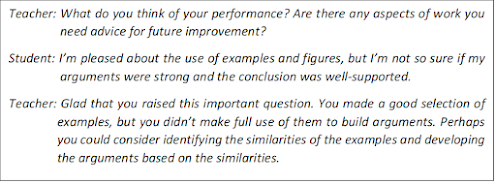
In view of the importance of trust, it is imperative for educators to enhance communication and competence trust in feedback exchanges. Table 1 below summarises the definition of communication trust and competence trust and outlines the strategies for trust building.

Table 1                      

Strategies for trust building


Students’ communication trust could be fostered if the feedback interaction is conducted in a psychologically safe environment, that is, an environment in which students feel safe to take interpersonal risks, admit ignorance and seek assistance from teachers (Johnson et al., 2020). The following three strategies would be useful in establishing such an environment.
Strategies to develop communication trust  

·      Setting a scene for candid feedback exchanges

Teachers could set the scene by stating the aim of feedback discussion and setting expectations at the outset of dialogue as follows:

Example 1   Setting a scene for candid feedback discussion


Students’ anxiety about feedback discussion could be relieved if they are clear about the purpose of the discussion and could see the value of an open discussion of problems and weaknesses.

·     Co-constructing feedback with students

Feedback co-construction involves teachers and students taking mutual responsibility for crafting feedback messages. As shown in example 2 below, this could be achieved by students making their feedback requests, followed by their teacher’s response to their needs. 

Example 2 Feedback co-construction


Allowing students to articulate feedback needs would be helpful for investing their trust in feedback interaction. When they know their feedback requests are accommodated seriously by teacher, they would be more motivated to discuss their weaknesses and would be psychologically ready to accept criticisms (To, 2021). The prerequisite for feedback co-construction is students’ capability to self-assess performance and identify their own learning challenges.

·      Empathy and attentive listening

Students’ psychological safety could be enhanced if teachers demonstrate empathy and attentive listening in their response to students’ feedback requests or explanation of learning difficulties. Illustrated by example 3, a teacher could show his / her understanding of the student’s difficulties and share his / her previous learning experience in the response.

 Example 3 Demonstrating empathy and attentive listening in feedback dialogue


When students feel teacher’s sincerity, they would be more willing to discuss their learning difficulties in the conversation. The atmosphere of sincerity could be further reinforced if teachers demonstrate the sympathetic attitude in regular classroom interaction (Carless, 2013).

Strategies to develop competence trust   

Given students’ prime concern about the quality of peer feedback, competence trust could be developed through peer feedback training and a quality check on peer feedback.

·       Peer feedback training

Peer feedback training could be incorporated into pedagogical activities to increase students’ capability to make academic judgements and construct peer comments. For example, prior to peer review activities, students could grade two to three exemplars of varied quality based on their understanding of assessment criteria and write comments to justify their evaluative decisions. Then, they could exchange their evaluative judgements and reasoning with teacher in a plenary session. Through the interaction, they could notice the judgement gaps and refine their initial understanding of quality. Teachers could also discuss with students the components of effective and ineffective peer feedback and demonstrate how to transform the ineffective feedback into effective ones.

·       Quality check on peer feedback

Teacher monitoring of the effectiveness of peer feedback could be achieved by different means. Inspired by Han and Xu (2020), teachers could collect peer feedback forms at the end of peer review and provide feedback on a random selection of peer comments with the aim of mediating students’ evaluative judgements. Alternatively, teachers could streamline the monitoring process using online platforms. For instance, when students post drafts for a collaborative writing project on Wiki or Google Classroom, teachers could have access to their drafts and peer feedback and offer input to refine the quality of peer comments during task engagement (Woo et al., 2013).

In conclusion, this article has examined the role of trust in feedback processes and has outlined some strategies to foster communication trust in teacher-student feedback exchanges and competence trust in peer feedback interaction. With a richer understanding of trust in feedback engagement, educators would be in a better position to design and implement effective feedback to enhance students’ engagement.

References

Carless, D. (2006). Differing perceptions in the feedback process. Studies in Higher Education31(2), 219-233. https://doi.org/10.1080/03075070600572132

Carless, D. (2013). Trust and its role in facilitating dialogic feedback. In D. Boud, & E. Molloy (Eds.), Feedback in Higher and Professional Education: Understanding it and Doing it Well (pp. 90-103). London: Routledge.

Han, Y., & Xu, Y. (2020). The development of student feedback literacy: The influences of teacher feedback on peer feedback. Assessment & Evaluation in Higher Education, 45(5), 680-696. https://doi.org/10.1080/02602938.2019.1689545

Johnson, C. E., Keating, J. L., & Molloy, E. K. (2020). Psychological safety in feedback: What does it look like and how can educators work with learners to foster it?. Medical Education, 54(6), 559-570. https://doi.org/10.1111/medu.14154

Panadero, E. (2016). Is it safe? Social, interpersonal, and human effects of peer assessment: A review and future directions. In B. Gavin, &  L. Harris (Eds.), Handbook of Human and Social Conditions in Assessment (pp. 247–266). New York: Routledge.

To, J. (2021). Using learner-centred feedback design to promote students’ engagement with feedback. Higher Education Research & Development. https://doi.org/10.1080/07294360.2021.1882403

Tschannen-Moran, M. (2014). Trust Matters: Leadership for Successful Schools (2nd edition). San Francisco: Jossey Bass.

Woo, M. M., Chu, S. K. W., & Li, X. (2013). Peer-feedback and revision process in a wiki mediated collaborative writing. Educational Technology Research & Development61(2), 279-309. https://doi.org/10.1007/s11423-012-9285-y

Yan, Z., & Brown, G. (2017). A cyclical self-assessment process: Towards a model of how students engage in self-assessment. Assessment & Evaluation in Higher Education, 42(8), 1247–1262. https://doi.org/10.1080/ 02602938.2016.1260091